Every betting affiliate program on AffiRank offers some mix of three commission models — RevShare vs CPA vs Hybrid is the first real decision you make as an affiliate. Programs like 1xPartners, Melbet Affiliates and 22Bet Partners advertise all three, and new affiliates in Nigeria, Kenya, Ghana, India or Bangladesh often pick whichever the signup form defaults to. That is a mistake. The model you choose decides how much you earn, when you get paid, how much risk you carry, and how the operator judges your traffic. This guide explains each model in plain terms, works through the numbers, and gives you a framework for choosing. Nothing here is a promise of income: affiliate earnings depend on your traffic, your market's legal situation, and player behaviour that you do not control.
1. What is RevShare?
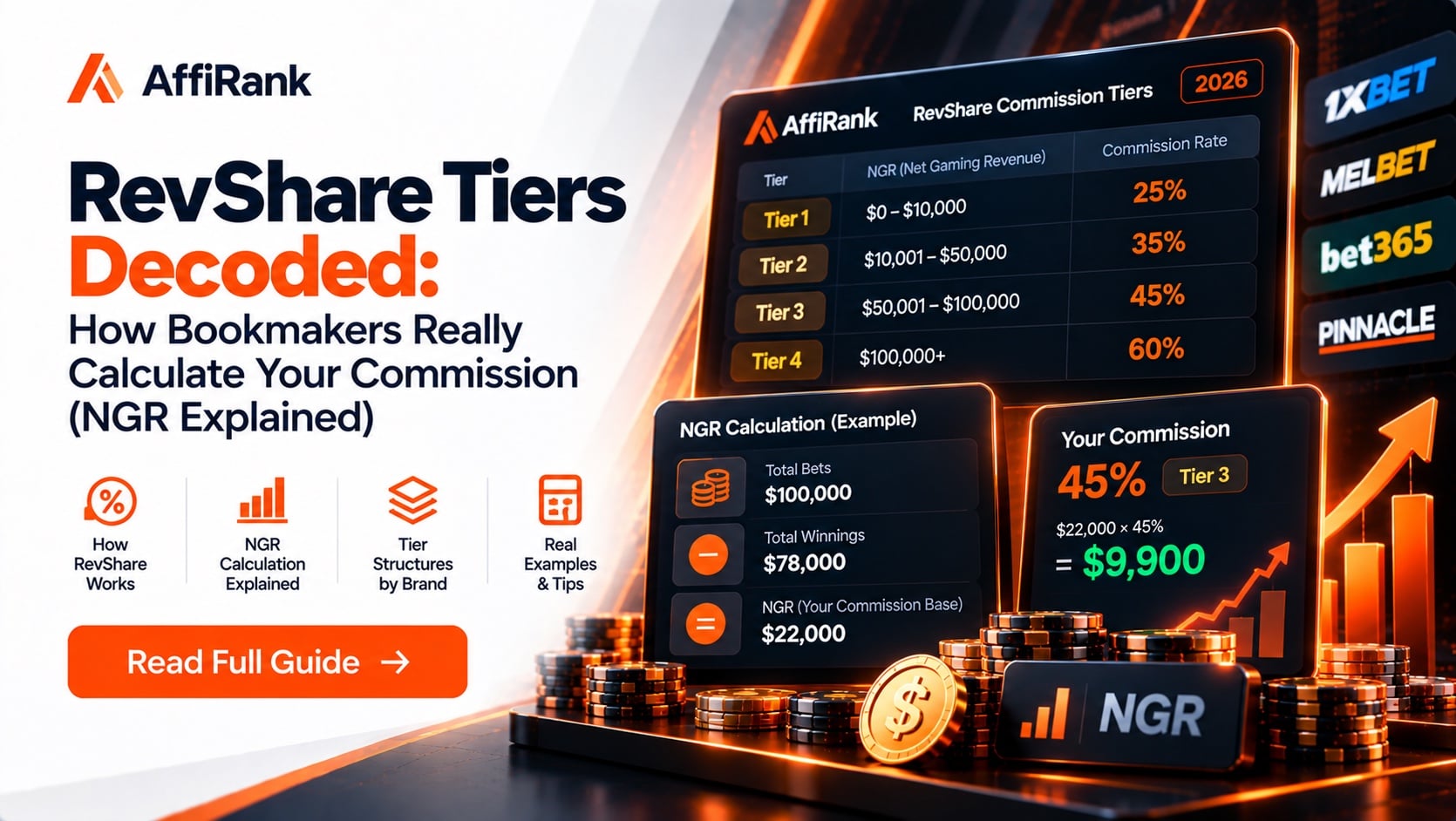
RevShare (revenue share) pays you a percentage of the net revenue the operator earns from players you referred, for as long as those players keep playing. Typical betting RevShare rates run from about 20% to 40% at the entry level, sometimes higher for large affiliates. 1xPartners, for example, publicly lists a 15% to 40% RevShare range, while Melbet Affiliates and Betwinner Affiliates advertise similar tiers.
The key term is net gaming revenue (NGR). It is roughly:
- Player bets minus player winnings (gross gaming revenue), then
- Minus bonuses, free bets, payment processing fees, and sometimes taxes and platform fees.
Your commission is a percentage of that NGR figure. If your players lose money to the operator, NGR is positive and you earn. If your players win big in a given month, NGR can be negative, and this is where negative carryover matters.
RevShare in practice
Suppose you refer 40 players in a month who together deposit and lose a net 800,000 NGN after bonuses and fees. At a 30% RevShare, your commission is 240,000 NGN. Next month, the same players (plus new ones) generate more NGR and you earn again. The upside is that revenue compounds as your player base grows. The downside is that revenue is lumpy, delayed, and dependent on player retention.
2. What is CPA?
CPA (cost per acquisition) pays a fixed one-time amount for each referred player who meets a defined action, normally a first deposit plus some qualifying activity. After that payment, the operator keeps all future revenue from the player.
CPA rates in African and South Asian markets are lower than in Europe because average deposits are lower. Publicly discussed ranges are wide, from around $5 to $50 or more per qualifying player, depending on country, traffic source and the operator's baseline. Programs such as Betwinner Affiliates, Megapari Partners and Paripesa Partners generally quote CPA on request rather than publicly, because the rate is set per GEO and per affiliate.
What you must check in a CPA deal
- The qualifying action. Registration alone rarely pays. Most programs require a minimum first deposit (for example 1,000 NGN, 500 KES or 500 INR) and often a minimum number of bets or turnover.
- The baseline. Many CPA deals include a "baseline" or "deposit-to-registration ratio" clause. If your registrations do not deposit at a high enough rate, the operator can reduce or cancel your CPA payouts for the period.
- Fraud and duplicate checks. Self-referrals, multi-accounting and incentivised traffic ("register and I will send you airtime") lead to voided CPAs and closed accounts.
- Caps. Some deals cap the number of CPAs paid per month until the operator has verified your traffic quality.

3. What is Hybrid?
Hybrid combines a smaller CPA with a smaller RevShare. A typical structure might be $10 to $20 per qualifying player plus 10% to 20% lifetime RevShare. Mostbet Partners, 1win Partners and 4rabet Partners are examples of programs that promote Hybrid deals for Indian and Bangladeshi traffic, while PIN-UP Partners shows hybrid examples such as 25% plus $100 per FTD on its official site.
Hybrid is attractive because you get some cash up front to cover ad spend and still keep a share of long-term value. The tradeoff is that both halves are smaller than the standalone versions, and Hybrid deals are almost always negotiated rather than offered at signup.
4. Side-by-side comparison
| Factor | RevShare | CPA | Hybrid |
|---|---|---|---|
| Payment timing | Monthly, ongoing | One-time, after qualification | Both |
| Typical entry rate | 20% to 40% of NGR | $5 to $50+ per player (GEO dependent) | Lower CPA + lower RevShare |
| Cash flow for paid traffic | Slow, uncertain | Fast, predictable | Moderate |
| Long-term upside | High if players stay active | None after payout | Medium |
| Exposure to player wins | Yes, can go negative | No | Partial (RevShare portion) |
| Negative carryover risk | Depends on program terms | Not applicable | Depends on program terms |
| Baseline / quality clauses | Rare | Common | Common |
| Best for | Content sites, communities, SEO | Paid media, high-volume channels | Mixed traffic, scaling affiliates |
5. A worked example: the same 100 players under each model
Assume you refer 100 first-time depositors in one month. Assume the operator would pay $20 CPA in your GEO, 30% RevShare, or a Hybrid of $8 CPA plus 15% RevShare. Assume, for illustration only, that the average player generates $15 NGR in month one and then decays over six months. These numbers are hypothetical and vary enormously by country and traffic source.
| Month | Players still active | NGR from cohort | RevShare (30%) | CPA ($20) | Hybrid ($8 + 15%) |
|---|---|---|---|---|---|
| 1 | 100 | $1,500 | $450 | $2,000 | $800 + $225 = $1,025 |
| 2 | 55 | $900 | $270 | $0 | $135 |
| 3 | 35 | $600 | $180 | $0 | $90 |
| 4 | 25 | $450 | $135 | $0 | $68 |
| 5 | 18 | $350 | $105 | $0 | $53 |
| 6 | 14 | $280 | $84 | $0 | $42 |
| Total | $4,080 | $1,224 | $2,000 | $1,413 |
In this example, CPA wins over six months. But change one assumption and the answer flips. If a handful of players in that cohort become regular high-stakes bettors, month-six RevShare can exceed month-one RevShare, and over 18 months RevShare could overtake CPA comfortably. If instead the cohort includes one player who wins $3,000 in month two, the RevShare column goes negative and, under negative carryover, you earn nothing until the deficit is cleared.
You can run your own numbers with the commission calculator and the earnings estimator.
6. Market-specific factors for Africa and South Asia
The right model depends on where your players are, and the legal environment shapes both player behaviour and program terms.
- Nigeria, Kenya, Ghana, Tanzania, South Africa. These markets have licensing regimes (for example the National Lottery Regulatory Commission and state boards in Nigeria, the Betting Control and Licensing Board in Kenya, the Gaming Commission of Ghana, the Gaming Board of Tanzania, and provincial boards in South Africa). Some operators are locally licensed; many offshore brands are not. Locally licensed programs often have lower RevShare percentages but more stable player bases and more reliable payouts; most of the programs we track operate offshore, so check the licence notes on each program page. Player deposits tend to be small and frequent, which favours RevShare on volume and makes CPA baselines harder to hit.
- India. Online betting is regulated at the state level, and several states restrict or prohibit it. Operators serving India from offshore licences tend to offer aggressive CPA and Hybrid deals (4rabet Partners, Dafabet Affiliates, Mostbet Partners), but payment disruptions and regulatory changes can affect player activity and therefore RevShare income.
- Bangladesh and Pakistan. Online betting is legally restricted in both countries. Programs still accept traffic from these markets, but you carry legal risk as a promoter, deposits are often routed through informal channels, and RevShare can be volatile. Be honest with yourself about this before building a business on it.
Estimate RevShare, CPA and Hybrid earnings with your own inputs.
7. How to choose: a simple decision framework
- How do you get traffic? If you pay for it (Facebook, Google, native, Telegram ads), you need CPA or Hybrid to recover ad spend within weeks. If it is organic (SEO site, YouTube, Telegram community), RevShare lets you build an income that grows with your audience.
- How long do your players stay? If you promote prediction tips and your audience bets every weekend, RevShare compounds. If your traffic is bonus hunters who deposit once, CPA is safer.
- Can you survive a bad month? RevShare without a "no negative carryover" clause can produce zero-income months. If you cannot absorb that, choose CPA or negotiate the carryover clause.
- How much data do you have? Start on RevShare or Hybrid with 100 to 300 players, watch deposit rates and retention in the program dashboard, then negotiate CPA once you can prove quality. Managers at programs like 22Bet Partners and Melbet Affiliates are more willing to offer CPA when they can see your history.
- Compare programs, not just models. A 35% RevShare with negative carryover and a high minimum payout can be worse than 25% with no carryover and weekly payments. Use the compare tool to line up terms.
8. Common mistakes to avoid
- Taking the default. Many signup forms default to RevShare. That is fine for content affiliates but a poor fit for paid traffic.
- Ignoring the fine print. "Up to 50%" means tiered rates; the entry tier is usually 20% to 30%. CPA "from $50" usually applies to Tier 1 countries, not Nigeria or India.
- Sending mixed-quality traffic to a CPA deal. Baseline clauses can wipe out a month of payouts.
- Forgetting sub-affiliate income. Some programs pay a small percentage on affiliates you refer; use the sub-affiliate calculator to see whether it is meaningful.
- Promoting where you cannot legally promote. Platform bans and local law are real costs that no commission model fixes.
There is no single best model. RevShare rewards patience and audience quality, CPA rewards volume and conversion discipline, and Hybrid is a negotiated middle ground. Choose based on your traffic source, your cash flow, and the terms of the specific program, then revisit the decision every quarter with real data.