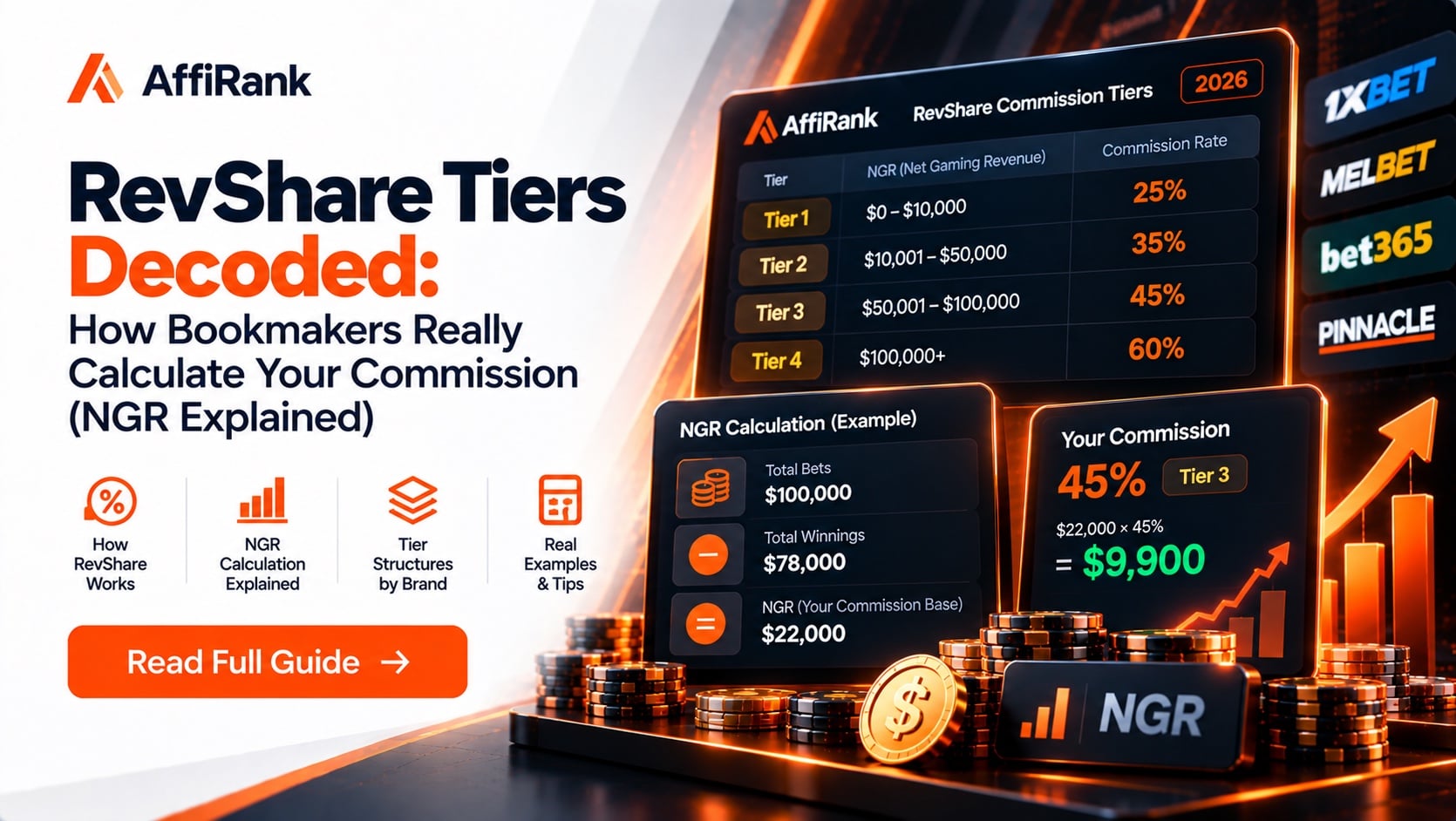
"Up to 45% RevShare" tells you almost nothing. It does not tell you what the 45% is applied to, when you get 45% instead of 15%, or what happens to the number when your players win. This guide explains the machinery behind RevShare tiers: how bookmakers calculate net gaming revenue (NGR), which deductions quietly shrink it, how tier ladders are structured at the programs we track, and how to compare two offers that look identical on a banner.
RevShare in one sentence
RevShare pays you a percentage of the net gaming revenue your referred players generate, for as long as they keep playing. Three parts of that sentence hide the details: *percentage* (the tier), *net gaming revenue* (the formula) and *for as long as* (carryover and lifetime tracking). If you need the basics of the three commission models first, start with RevShare vs CPA vs Hybrid.
The NGR formula, step by step
Every program's agreement defines NGR slightly differently, but the structure is always the same:
| Step | Item | Example (100 players, one month) |
|---|---|---|
| 1 | Total bets (turnover) | $100,000 |
| 2 | − Winnings paid to players | − $92,000 |
| = | Gross gaming revenue (GGR) | $8,000 |
| 3 | − Bonuses and free bets used | − $1,200 |
| 4 | − Payment processing fees | − $400 |
| 5 | − Chargebacks and fraud write-offs | − $200 |
| 6 | − Gaming taxes / licence fees (where deducted) | − $400 |
| 7 | − Administrative or platform fee (some programs) | − $800 |
| = | Net gaming revenue (NGR) | $5,000 |
| 8 | × Your RevShare rate | 35% |
| = | Your commission | $1,750 |
Notice that steps 3–7 removed 37.5% of GGR before your percentage was applied. In this example, "35% of NGR" is effectively 21.9% of GGR. A program paying "30% of GGR" would have paid $2,400 — more money at a lower headline rate.
The deductions that matter most
- Bonuses. The biggest and most variable deduction. Aggressive welcome bonuses attract players but every bonus dollar your players use comes out of your NGR. Programs that push huge bonuses in Bangladesh or Nigeria can generate large turnover and thin NGR.
- Payment fees. Usually 2–5% of deposits and withdrawals; higher for card and mobile-money processing in some African markets.
- Taxes. In regulated markets (Kenya, Nigeria, South Africa) betting taxes may be deducted before NGR, which is one reason licensed brands sometimes offer lower percentages than offshore ones — the base is cleaner but smaller.
- Administrative fee. A flat 5–15% of GGR some programs deduct "for platform costs". It is the deduction most worth negotiating away, because it is the least tied to real cost.
- Chargebacks. Deposits reversed by the player's bank. Also the usual reason for clawbacks later.
How tiers really work
A RevShare tier ladder raises your percentage as you deliver more. Tiers are usually measured in one of two ways:
- First-time depositors (FTDs) per month — e.g. 0–10 FTDs → 25%, 11–30 → 30%, 31+ → 35%.
- NGR generated per month — e.g. up to $5,000 → 25%, $5,000–20,000 → 35%, above → 45%.
And applied in one of two ways:
- Whole-balance tiers: cross the threshold and the new rate applies to all NGR that month. Generous, and the common case in betting.
- Marginal tiers: the higher rate applies only to NGR above the threshold, like income-tax bands. Less generous, and worth spotting.
Most betting programs in our markets publish no formal ladder at all. Instead the agreement states a range ("15–40% depending on geography and number of referred players", to quote 1xPartners' FAQ) and the manager moves you within it. That is a tier system too — just an opaque one, where the thresholds are whatever you can negotiate.
Published and reported ladders at programs we track
| Program | Published range | Ladder (published or reported) | Notes |
|---|---|---|---|
| Megapari Partners | 15–50% | 20% intro, then 15–25% floor per T&Cs; 50% negotiated | Marketing far above the published floor |
| 1xPartners | 15–40% | ~20% start → 25–30% → 35–40% (reported) | 45% advertised; thresholds unpublished |
| Melbet Affiliates | 25–40% | 25% default → 30–35% → 40% (up to 50% reported) | Default written into the agreement |
| Mostbet Partners | 30–60% | 30–50% on official site; 60% reported top | No negative carryover |
| 1win Partners | 50–60% | Flat high range; conditions on payout instead | 10-active-player rule before first withdrawal |
| Dafabet Affiliates | 30–40% | Volume-based | Negative carryover; monthly payouts |
| 7StarsPartners (Rabona) | 45–60% | Casino 45% (0–15 FTDs) → 50% → 55% → 60% VIP; sports 30–45% | No negative carryover; admin fees and bonus costs deducted before the rate applies |
| Sapphirebet Partners | 25–50% | 25% → 50% across six NGR bands (50% above 100,001) | Ladder published in the terms; monthly payouts |
| SpinBetter Partners | 20–50% | 20% (0–9 FTDs) → 50% (100+ FTDs per month) in seven steps | Ladder published in the terms; negative carryover |
Full ranges for all 26 programs are in the best betting affiliate programs roundup.
Worked example: the same players, three programs
Take an affiliate whose 150 active players generate $10,000 of GGR in a month. Three programs, three outcomes:
| Program terms | Deductions before NGR | NGR | Rate | Commission |
|---|---|---|---|---|
| A: "45% RevShare", bonuses + fees + 15% admin fee deducted | $4,500 | $5,500 | 45% | $2,475 |
| B: "35% RevShare", bonuses + fees only | $2,000 | $8,000 | 35% | $2,800 |
| C: "30% of GGR" (no deductions) | $0 | $10,000 | 30% | $3,000 |
The lowest headline rate paid the most. This is not unusual; it is the normal outcome when an admin fee is involved. The commission calculator lets you enter deductions explicitly so you compare offers on money, not percentages.
Other bases you will meet: GGR deals, flat NGR and hybrid definitions
Not every program uses the full NGR ladder above. Three variants are common enough to recognise:
- GGR-based RevShare. The percentage is applied to bets minus winnings with no further deductions. Rates are lower (20–30%) but the base is bigger and fully transparent. Rare among the CIS-rooted bookmakers, more common at regulated African brands.
- "Net profit" with an admin fee. Melbet's agreement, for example, pays a percentage of *net profit* — GGR less bonuses, fees and costs — which is standard NGR by another name. Check whether an administrative percentage is included in "costs".
- Product-split rates. Some programs pay different percentages for sports and casino from the same players (casino often higher because margins are higher). Your effective rate then depends on what your audience plays.
Whatever the label, the questions are the same: what is subtracted, and is it written down?
How to audit your monthly statement
Dashboards show a commission figure; few affiliates check how it was reached. A ten-minute monthly audit catches most problems early:
- Export the period's player report with deposits, bets, winnings and bonuses per player where the program provides it.
- Recompute GGR (bets − winnings) and compare it with the dashboard's gross figure. Large gaps usually mean players were removed or reassigned.
- Add up the deductions the program shows (bonuses, fees, admin) and check the implied NGR. If the deduction ratio jumps from 20% to 40% in one month, ask why — a bonus campaign or a fee change is the usual answer.
- Apply your rate to NGR and compare with the commission paid. A mismatch means either a tier change you were not told about or a carried-over negative balance.
- Log the result in a simple spreadsheet: GGR, deductions, NGR, rate, commission. Over a few months the trend tells you whether the program's definition is stable — and gives you the evidence to negotiate.
If a statement cannot be reconciled and the manager cannot explain it, that is a stronger reason to move traffic than a slightly lower percentage elsewhere. Betting Affiliate Payments Explained covers what to do when a payment itself is late.
Negative months and carryover
NGR can be negative. If your players win $3,000 more than they lose in a month, NGR is −$3,000 and your commission is zero. What happens next depends on the carryover clause:
- Negative carryover (1xPartners, Melbet, Megapari, Paripesa, Betwinner, Dafabet, PIN-UP, 1xCasino, SpinBetter, WinWin, Planbet, DBbet): the −$3,000 rolls forward. You earn nothing until your players lose $3,000 more — potentially months for a small base.
- Monthly reset (Mostbet, 4rabet, Roobet, Stake, 7StarsPartners): the deficit is written off and you start the next month at zero.
Over a year, a monthly reset can be worth more than 10 extra points of RevShare for an affiliate with a small, high-variance player base. Negative Carryover Explained has the month-by-month arithmetic.
Lifetime, cookies and "for as long as they play"
RevShare is normally lifetime: a player tagged to you generates commission every month they are active. Two limits apply. The attribution cookie (commonly 30 days, reported at both 1xPartners and Melbet) decides whether a click becomes your player if they register later. And most agreements let the program stop paying on players inactive for a long period or reassign them in disputes. Lifetime is a policy, not a guarantee — read the "inactive players" clause.
Questions to ask before you accept a RevShare deal
Take this list into the first conversation with any affiliate manager. The answers are more predictive of your income than the headline percentage, and a manager's willingness to answer them is itself useful information about the program.
- What exactly is deducted between GGR and NGR? Is there an administrative fee, and what percentage?
- What is my starting rate for my country, and what volume moves it to the next tier?
- Are tiers applied to the whole balance or marginally?
- Is negative balance carried forward, and is there any cap or monthly reset?
- How long is the attribution cookie, and when are inactive players removed?
- Are there payout conditions beyond the minimum balance (new depositors, active players)?
Get the answers in writing, save the dashboard screenshot of your rate, and revisit the conversation every quarter with your numbers — a rate review request backed by three months of reconciled statements is rarely refused. The programs that pay best are rarely the ones with the biggest percentage on the banner; they are the ones with the cleanest NGR, the fairest carryover rule and a manager who moves your tier when you earn it. How those numbers translate into monthly income is covered in How Much Do Betting Affiliates Really Earn?.
Estimate RevShare, CPA and Hybrid earnings with your own inputs.