Betting affiliate payments look simple on the signup page: every program promises fast payouts. Every affiliate forum is full of people asking why theirs has not arrived. Both are true because "weekly payouts" describes the calendar, not the conditions. This guide explains the full path from a player's deposit to money in your account — payout schedules, minimum thresholds, hold and verification periods, the rules that quietly pause payments — using the published terms of the 26 programs in our directory, and it ends with a checklist that keeps most affiliates out of the support queue.
How a commission becomes a payment
- A referred player deposits and bets. Your dashboard shows registrations, first-time depositors (FTDs) and, for RevShare, the net gaming revenue they generate.
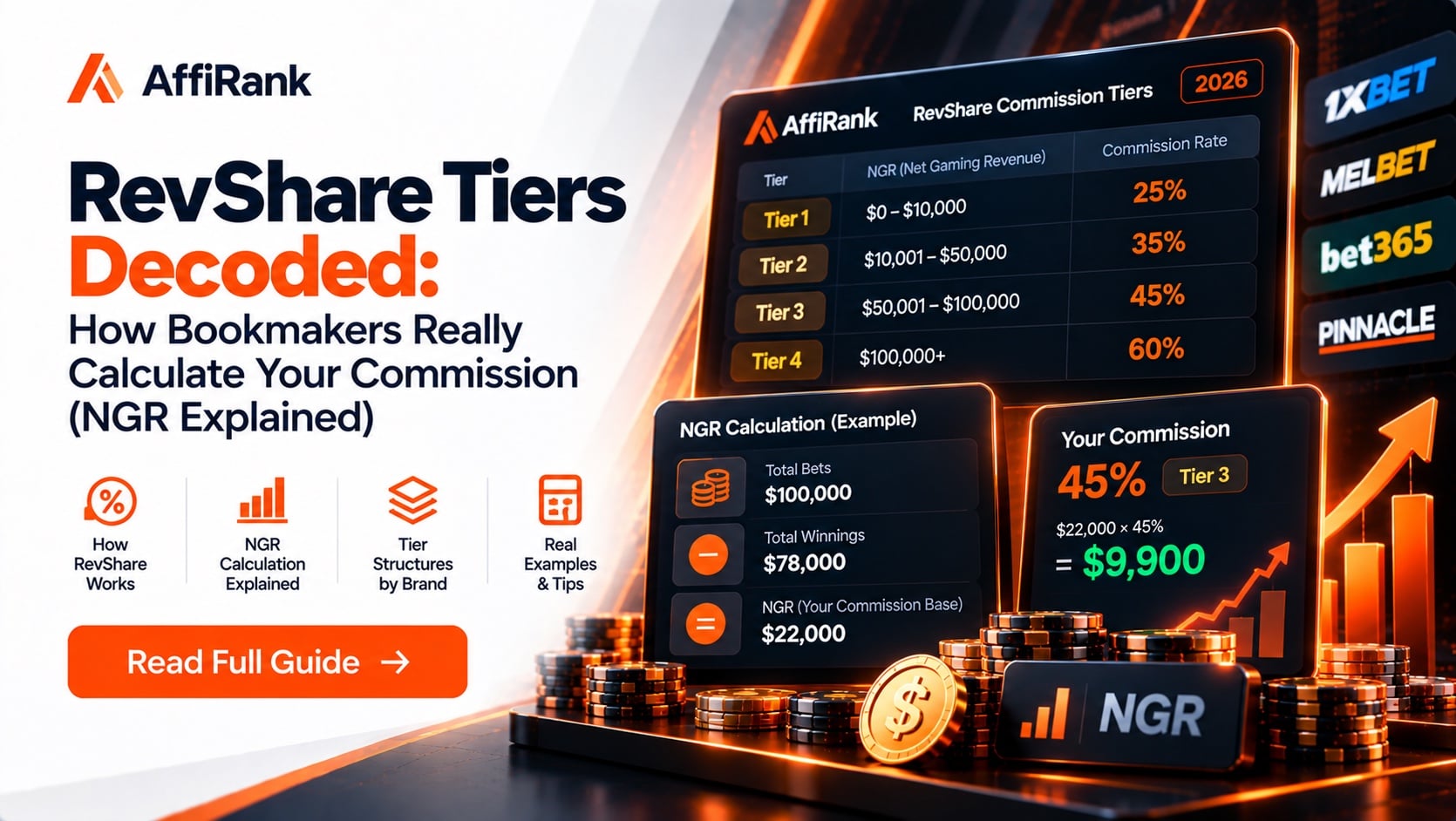
- The program calculates your commission for the period — weekly or monthly — using its RevShare formula (RevShare Tiers Decoded explains the NGR deductions) or its CPA conditions.
- Conditions are checked: minimum balance, minimum new users or active players, negative balance from previous periods, any open verification.
- The payment is released by the program's method and schedule, or the balance rolls forward.
- Your bank, wallet or exchange receives it, minus fees and, for crypto, network costs.
Delays can happen at steps 3, 4 and 5, and most affiliates only look at step 4.
Payout schedules across the programs we track
| Schedule | Programs | Notes |
|---|---|---|
| Daily | BC.Game Affiliates | Daily crediting, instant crypto withdrawal; managed deals reported monthly |
| Weekly (Tuesday) | 1xPartners, Melbet, Megapari, Paripesa, 1win, 1xCasino, WinWin, Planbet, DBbet, PariPulse, BetOnGame, FairPari | For the previous Monday–Sunday period; Melbet CPA reported twice weekly |
| Weekly (other) | 4rabet (NET7), Coldbet (every 7 days by default), SpinBetter (weekly advertised; NET7–NET60 in terms) | Day set by the program or your manager |
| Twice monthly | PIN-UP Partners (CPA; RevShare on request) | Periods 1st–15th and 16th–month end, paid within 10 days per the agreement |
| Weekly on request | Mostbet Partners | Not automatic; 10-active-player condition reported |
| Program discretion | Betwinner | NET-7 to NET-60 depending on your plan |
| Monthly | 22Bet (by the 15th), Stake, Roobet, Dafabet, Sapphirebet (second week), 7StarsPartners (by the 20th) | Usually 10–20 days after month end |
Weekly is better for cash flow, obviously. But monthly programs are often the ones with no negative carryover (Roobet, Stake, 7StarsPartners) and, at Stake, no minimum payout, so the trade-off is real.

Minimum payouts and the rules hiding next to them
The minimum balance is the number everyone checks. The rules next to it are the ones that stop payments.
| Minimum payout | Programs | Extra condition worth knowing |
|---|---|---|
| None | BC.Game, Stake | Paidbet's minimum is not published |
| $30 | 1xPartners, Melbet, Megapari (T&Cs mention $100), Paripesa, Betwinner, 1xCasino, WinWin, Planbet, DBbet, PariPulse, BetOnGame, FairPari, Coldbet (weekly cycle) | 1xPartners, Melbet and 1xCasino: more than 4 new depositing users per period, otherwise the balance rolls forward; Planbet and BetOnGame need four referred players, DBbet and FairPari three |
| $50 | Mostbet, PIN-UP, SpinBetter (EUR 50) | Mostbet: 10 active players reported before first payout; PIN-UP: 10 qualified users within six months, and $200 for USDT ERC20 |
| $70 | 1win Partners | 10 active players before first withdrawal |
| $100 | 4rabet, 22Bet, Dafabet, Roobet, Sapphirebet, 7StarsPartners (EUR 100; EUR 500 in current T&C) | 22Bet and Megapari terms allow delays up to 2 months during checks; Roobet needs 5 depositing customers first |
Hold and verification periods
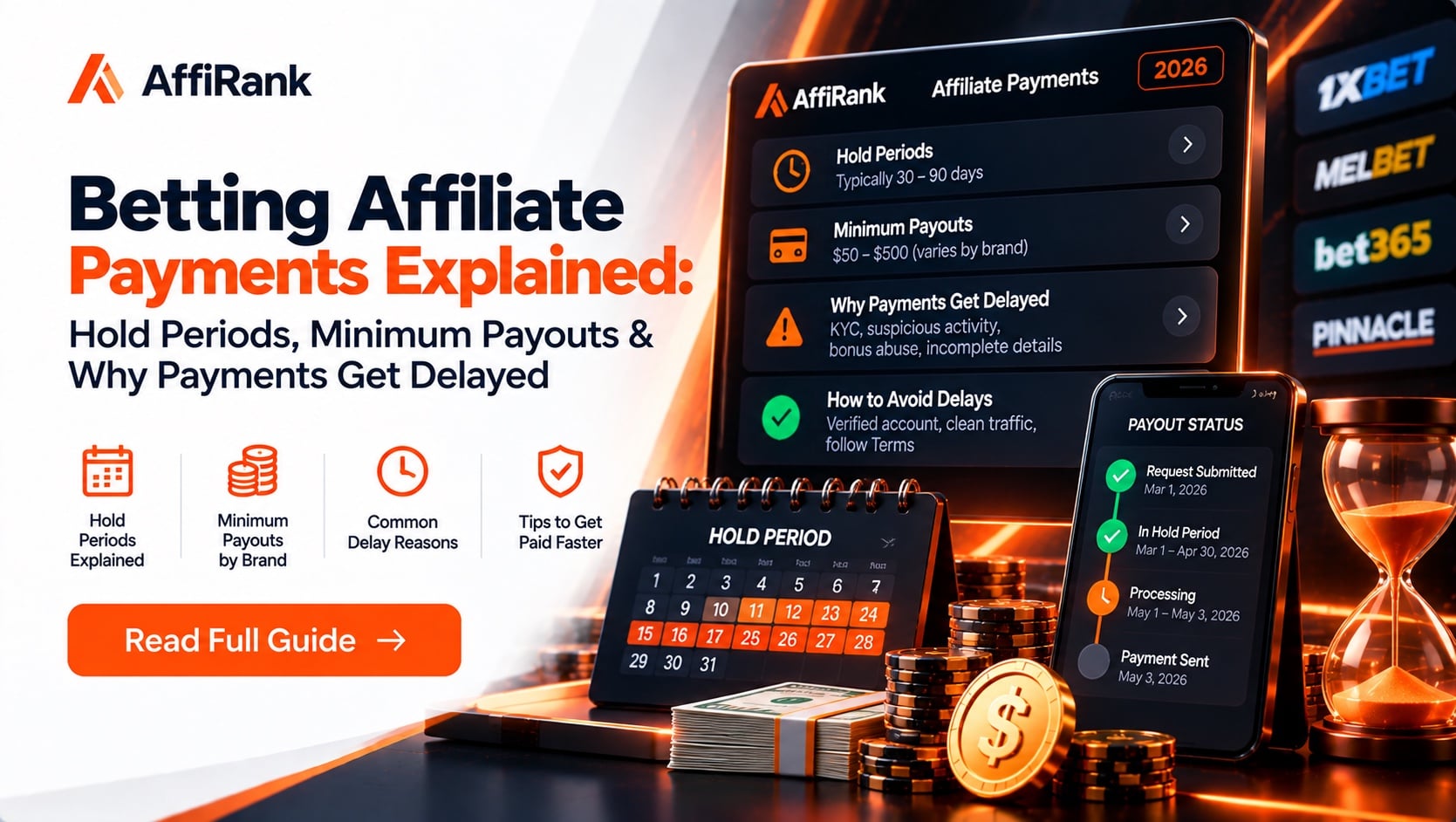
A hold period is the gap between earning a commission and being allowed to withdraw it. Programs use it to confirm the player is real, has passed KYC, has not charged back a deposit and is not abusing bonuses. Industry-wide, 30–60 day holds are common for CPA; in betting affiliation the picture is more varied:
| Program | Hold / verification (published or reported) |
|---|---|
| 1xPartners | None by default; traffic-verification holds up to 90 days reported |
| Melbet Affiliates | None by default; terms allow a verification period of up to 90 days |
| Mostbet Partners | Reported 2 business days, up to a 14-day anti-fraud check |
| 1win Partners | 7 days on CPA (official); none published for RevShare |
| Megapari Partners | None stated for RevShare; CPA held ~14 days reported; T&Cs allow delays up to 2 months for technical failures |
| PIN-UP Partners | No fixed hold for RevShare; CPA subject to KPI review (repeat deposit within 14 days, bets 3x deposits) and can be withheld or reclassified |
| Paripesa Partners | 14–21 days reported for traffic validation |
| 4rabet Partners | 1 week from conversion per T&C; longer holds reported for flagged traffic |
| Dafabet Affiliates | Approximately 10 days verification after month end |
| Coldbet, SpinBetter | 7–28 days on CPA per their official sites |
| Stake, BC.Game, Roobet, 22Bet, Betwinner, Sapphirebet, Paidbet | Not published or depends on plan |
The pattern: default holds are short or absent, but almost every agreement contains a clause allowing a long freeze if traffic is questioned. That clause, not the schedule, is what produces the "paid weekly for six months, then nothing for two" stories in reviews.
Why payments actually get delayed
From the terms above and from affiliate reports, the reasons in rough order of frequency:
- You did not meet a threshold. Balance below minimum, fewer than the required new users or active players. The dashboard rarely says so explicitly — it just shows the balance rolling forward.
- A negative balance is being recovered. After a month in which your players won, programs with negative carryover pay nothing until the deficit is cleared. Negative Carryover Explained shows how long that can take.
- Traffic verification. A spike in registrations, many accounts from one device or IP range, unusual deposit patterns or a high bonus-to-deposit ratio triggers a manual review. Payments pause for the review period allowed in the terms.
- Your own KYC or payment details. First payouts, large payouts and payment-method changes commonly require identity documents. Missing or mismatched details (name on the bank account differing from the affiliate account, for example) stall the transfer.
- Payment-method failures. Bank wires to some countries bounce; e-wallet accounts are unverified; a crypto address is on the wrong network. The program marks it paid, the money returns, and the next cycle starts.
- Program-side issues. Public holidays, processor changes, or the two-month technical-failure clauses some programs reserve.
- Disputes and clawbacks. Chargebacks by players, suspected fraud or a terms breach can lead to a deduction or a refusal. This is the least common reason and the hardest to reverse.
What to do when a payment is late
- Check the conditions first (minimum, user count, negative balance). Most "delays" are rule outcomes.
- Check your account status and messages for a KYC or documents request — programs often notify in the dashboard, not by email.
- Write to your manager once, clearly: period, expected amount, payment method, and what you have already checked. Attach nothing unrelated.
- Keep your traffic log ready: where the players came from, screenshots of posts or ads, dates. If the delay is a verification, this shortens it and protects you in a dispute.
- Escalate after the documented window. If terms allow a 90-day verification, a complaint on day 20 goes nowhere; a documented complaint after the window has weight, including on public forums that programs monitor.
- Do not send more traffic to a program that has frozen you until it is resolved. Diversify — the best betting affiliate programs roundup lists alternatives with different terms.
Payment methods, fees and speed
- Bank transfer: widely offered; slow (2–7 business days) and expensive for small amounts, with correspondent fees for many African and South Asian banks.
- E-wallets (Skrill, Neteller, WebMoney, Perfect Money, ecoPayz/Payz): fast, but withdrawal to a local bank adds another fee, and account verification is strict.
- Crypto (USDT, Bitcoin): offered by almost every program we track; USDT on TRC20 settles in minutes for a fee of about $1. Convert on a local exchange. See programs that pay via USDT and our guide to crypto-paying betting affiliate programs.
- Mobile money and local wallets: no live program pays affiliates by M-Pesa from the dashboard; Megapari and Mostbet list bKash and Nagad (Planbet's are catalog-reported); 1xPartners' M-Pesa, bKash, UPI and Paytm payouts are reported via a player account rather than the affiliate dashboard.
Pick a method once and keep it. Changing payout details is itself a common trigger for verification, and a mismatch between the name on your affiliate account and the name on the receiving account is the single most common reason a first payout bounces back to the program.
Currency, taxes and record-keeping
Commissions are almost always calculated in US dollars or euros even when your players deposit in naira, shillings, rupees or taka. Three consequences:
- Exchange rates cut both ways. A weakening local currency raises your commission in local terms; a strengthening one lowers it. Programs convert player activity to USD at their own rates, which are not always published — ask if your dashboard numbers do not match your expectations.
- Conversion fees are a real cost. Bank wires, e-wallet withdrawals and USDT sales each take 1–3% or more. Choose the route with the fewest hops for your country.
- Commissions are taxable income in every market we cover, and crypto conversions may be taxed separately. Keep a simple ledger per payout: date, program, period covered, amount in USD, method, fees, local amount received. It takes two minutes per payment, makes reconciliation trivial and is exactly what a program asks for when a dispute is escalated.
A checklist that avoids most payment problems
- Read the payout section of the agreement, not the marketing page, and write down: schedule, minimum, user/active-player rules, carryover, verification window.
- Complete KYC before your first payout is due, with details that match your payment account exactly.
- Log traffic sources from day one so a verification request is a five-minute reply, not a two-week scramble.
- Choose at least one program with no negative carryover and one with a low minimum so a bad month at one program does not stop all income.
- Reconcile weekly: dashboard balance versus expected commission versus received amount. Small discrepancies caught early are easy to fix.
- Avoid the behaviours that trigger reviews — 10 Mistakes New Betting Affiliates Make lists them.
Payments in this industry are reliable for affiliates who understand the conditions and unreliable for those who read only the headline. Know the rules, keep the records, and most of the horror stories will happen to someone else.
Filter every listed program by country, payment method and commission model.