Negative carryover is the clause that separates a good RevShare deal from a painful one. It rarely appears under that name in the terms, most affiliates in Nigeria, Kenya, Ghana, India and Bangladesh never read the section where it lives, and it only bites after a big player win, which is exactly when you least expect to lose income. This guide explains what negative carryover is, how programs word it, what it does to your commissions month by month, and what you can do about it. It applies to RevShare and to the RevShare part of Hybrid deals at programs like 22Bet Partners, 1xPartners, Melbet Affiliates and PIN-UP Partners.
1. What negative carryover actually is
Under a RevShare deal you are paid a percentage of the net gaming revenue (NGR) your referred players generate. NGR is what the operator keeps after paying out winnings, bonuses, payment fees and sometimes taxes. Most months, your players lose more than they win in aggregate, NGR is positive, and you get your percentage.
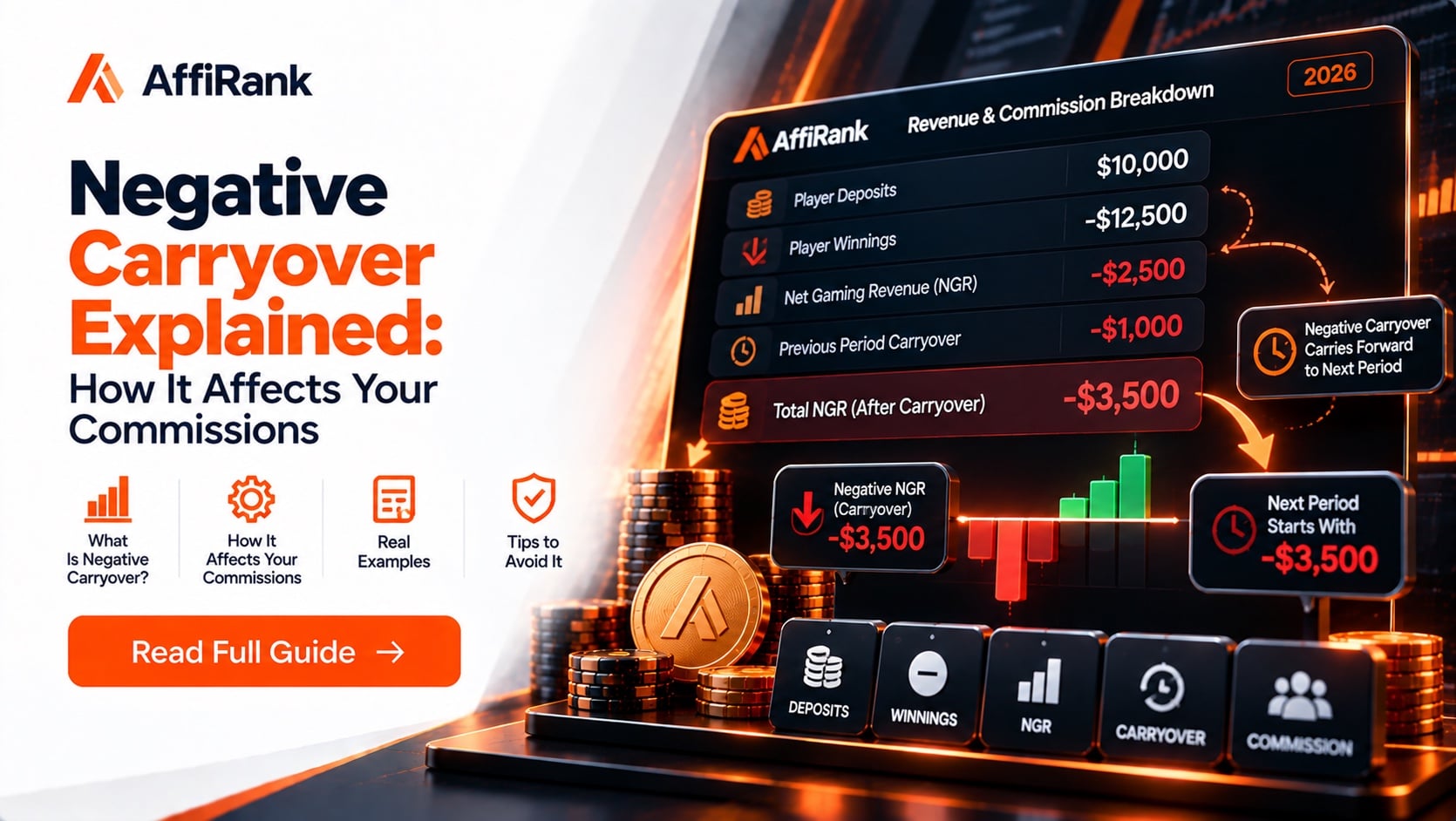
Occasionally a player wins big. A 50,000 KES accumulator lands, or an Indian player hits a large casino jackpot. In that month, the payouts to your players can exceed the amount they bet and lost, and NGR for your account goes negative. Your commission for the month is then negative too.
The question is what happens to that negative figure on the first day of the next month:
- With negative carryover: the deficit rolls forward. You start next month below zero and earn nothing until new NGR from your players has covered the gap.
- Without negative carryover (monthly reset): the deficit is written off. You start next month at zero and earn from the first positive NGR.
That is the entire difference, and it can be worth months of income.
2. How the clause is worded in affiliate terms
Programs almost never write "negative carryover" in their terms and conditions. You have to recognise the concept from phrases like:
- "Negative balances will be carried forward to subsequent periods."
- "Any deficit in the affiliate's account from one month will be deducted from future commissions."
- "Commissions are calculated on a cumulative basis across all months."
- "Where net revenue is negative, the negative amount shall be offset against commission earned in following months."
The opposite policy is usually stated more proudly, because it is a selling point: "No negative carryover," "Negative balances are reset to zero at the start of each month," or "Monthly NGR is calculated independently."
Some terms are more subtle. A program might reset negative balances monthly but apply carryover across brands (if you promote several brands owned by one company), or reset only if the negative balance is below a threshold. A few reserve the right to switch a high-risk affiliate to carryover terms after a large loss. Read the whole commission section, not just the headline percentage.

3. A month-by-month example
Assume you are on a 30% RevShare with 80 active players and, in a normal month, they generate about $2,000 NGR. In month three, one player wins $9,000, pushing NGR for your account to minus $6,000. The table shows your commission under both policies. Figures are hypothetical and rounded.
| Month | NGR from your players | Commission with negative carryover | Commission with monthly reset |
|---|---|---|---|
| 1 | $2,000 | $600 | $600 |
| 2 | $2,200 | $660 | $660 |
| 3 | -$6,000 (big win) | -$1,800 carried forward, $0 paid | $0 paid, balance reset |
| 4 | $2,100 | $630 offsets deficit, balance -$1,170, $0 paid | $630 |
| 5 | $1,900 | $570 offsets deficit, balance -$600, $0 paid | $570 |
| 6 | $2,300 | $690 minus $600 deficit = $90 paid | $690 |
| 7 | $2,000 | $600 | $600 |
| Total (7 months) | $6,500 | $2,550 | $3,750 |
Same players, same NGR, same 30% rate. Negative carryover cost this affiliate $1,200 over seven months, roughly a third of the income they would have received under a monthly reset. If the win had been $20,000 instead of $9,000, the deficit would have taken most of a year to clear.
Note that in both cases month three pays nothing. No negative carryover does not mean you get paid when your players win; it means you do not keep paying for that win afterwards.
4. Who is most exposed
Negative carryover hurts some affiliates far more than others.
- Small player bases. With 30 players, one big win dominates your NGR. With 3,000 players, individual wins are absorbed by the crowd. Affiliates just starting out in Ghana, Tanzania or Pakistan with a few dozen referrals are the most exposed.
- Sports-heavy traffic. Accumulator bettors produce rare but large wins. Casino traffic tends to generate smoother NGR, although jackpot slots can still cause a bad month.
- High-stakes players. One VIP who bets large amounts can swing your account either way. Programs love VIPs; under carryover, you carry their variance.
- Multi-brand promotion. If a program pools your balance across brands, a loss on one brand offsets earnings on another.
- Affiliates who depend on monthly payouts. If your commission is your ad budget or your rent, three zero months can end the business even though the long-term maths still favours RevShare.
5. How the major programs handle it
Policies change, and the only reliable source is the current terms in your own affiliate account. That said, there are patterns. Several large offshore programs popular with African and South Asian affiliates, including 1xPartners, Melbet Affiliates, Betwinner Affiliates, Megapari Partners and Paripesa Partners, have historically advertised no negative carryover as a feature for standard RevShare deals. Others state that negative balances carry over by default and remove the clause only for negotiated deals. Crypto-focused programs such as Stake Partners and BC.Game Affiliates tend to have larger casino components and their own variance rules.
Locally licensed operators in Kenya, Nigeria and South Africa sometimes have stricter, less negotiable terms because their affiliate programs are run under regulatory oversight; most of the programs we track operate offshore, where the clause is set by the program itself.
Each program page on AffiRank lists what we found in the public terms and what affiliates reported to us. Verify it against your own account before relying on it, because terms at signup can differ from terms for your specific deal. Use the compare tool to view carryover policy alongside rates and payout thresholds.
Here is what we found in the public terms and affiliate FAQs of the 26 programs we track. "Reported" means the policy comes from affiliate reports rather than the agreement itself; verify it in your own account.
| Policy | Programs |
|---|---|
| No negative carryover (period reset) | Mostbet Partners, 4rabet Partners, Roobet Partners (except single-player losses above $10,000), Stake Partners, 7StarsPartners (Rabona) |
| Negative balance carried forward | 1xPartners (official FAQ), Melbet Affiliates (agreement), Megapari, Betwinner, Dafabet, PIN-UP Partners (standard RevShare; RevShare+ resets), 1xCasino, Coldbet, SpinBetter (waived only at very high volume), WinWin, Planbet, DBbet, PariPulse, BetOnGame, FairPari |
| Not published / unclear | BC.Game, 1win Partners, 22Bet Partners, Paripesa (carryover reported by reviewers), Sapphirebet, Paidbet |
Two patterns stand out. The weekly-paying CIS brands almost all carry balances forward — they pay fast, but a winning week for your players is deducted from the next one. The programs that reset are either casino-led or crypto-native programs (Roobet, Stake, 7StarsPartners) or bookmakers that compete on terms rather than brand (Mostbet, 4rabet). If a program is "unclear", ask in writing before you send traffic; a manager who will not answer that question is answering it.
Filter every listed program by country, payment method and commission model.
6. How to protect yourself
- Read the commission section before you send a single click. Search the terms for "negative," "carried," "deficit," "cumulative" and "offset."
- Ask the manager in writing. A simple message: "Does my RevShare deal have negative carryover? If yes, can it be removed?" Keep the reply. If they agree, ask for the change to be reflected in your account terms.
- Negotiate a reset once you have data. Programs are more flexible once you have three to six months of consistent traffic. No negative carryover is a common concession for affiliates who ask.
- Consider Hybrid or CPA for small or high-variance traffic. If your player base is under 100 or is dominated by accumulator bettors, a CPA component removes most of the variance. Our RevShare vs CPA vs Hybrid guide covers the tradeoffs.
- Diversify across programs. A bad month at one program does not affect your balance at another. Spreading traffic between two or three programs reduces the chance that a single win zeroes your entire income.
- Model the worst case. Use the commission calculator to see how long a given deficit would take to clear at your typical monthly NGR. If the answer is more than two months, the deal needs a reset clause.
- Watch for retroactive changes. Some programs reserve the right to change terms with notice. If a program moves you onto carryover after a big loss, that is a signal about how they treat partners.
7. What negative carryover is not
A few things get confused with negative carryover and are worth separating.
- Admin fees and deductions. Bonuses, payment processing costs and platform fees are deducted from gross revenue every month regardless of carryover. They reduce your NGR, but they are not carryover.
- Chargebacks and fraud clawbacks. If a player's deposits are reversed or found fraudulent, the program may reverse the associated commission. That is a separate clause with its own rules.
- CPA baseline reductions. CPA deals can be reduced if your deposit rate falls below a baseline. That is a quality control, not carryover.
- Minimum payout thresholds. Not reaching the payout threshold means your balance waits, not that it is negative.
Negative carryover is one specific mechanism: a negative NGR month reducing your future positive months. Knowing exactly what it is makes it easier to ask the right question and to spot when a manager gives you a vague answer.
For most affiliates in African and South Asian markets, the practical rule is simple. If you are small, new, or sports-heavy, avoid negative carryover or take a CPA or Hybrid deal. If you are large and diversified, carryover matters less, but it is still worth negotiating away, because there is no upside to it for you.